Apple Life Cycle: A Fall Science Activity
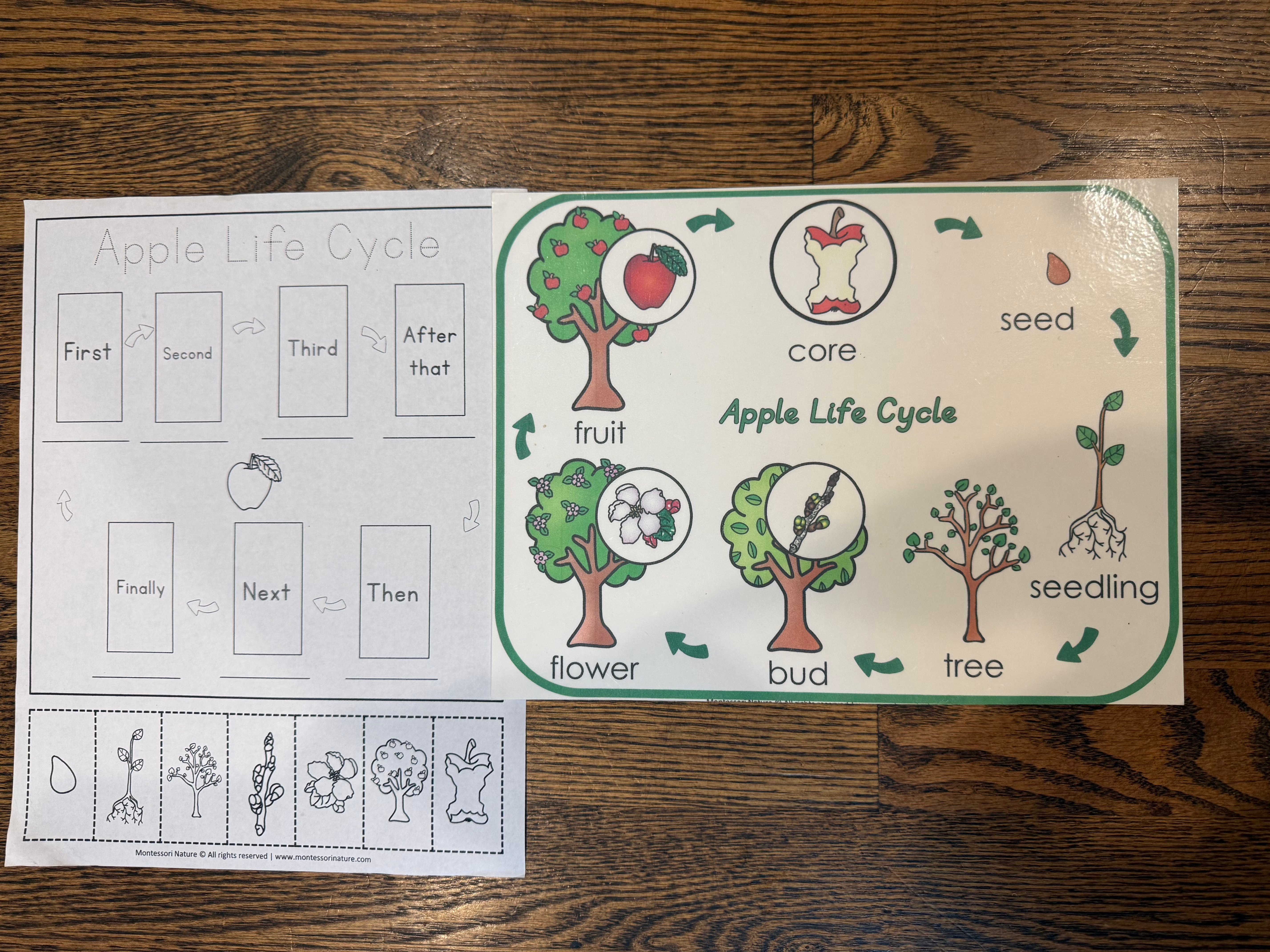
The apple life cycle is a perfect fall science topic because the end result — a ripe apple — is something children know well and love. Working backwards from the apple to the seed, and then forward again through all the stages, builds the kind of sequential scientific thinking that underpins later biology, ecology, and environmental science.
What You'll Need
An apple life cycle diagram (seed → seedling → tree → bud → flower → fruit) — laminated for repeated use.
A sequencing worksheet where children cut out and arrange the life cycle stages in order.
Optional: an accordion fold-out book template (children colour each stage and fold the pages into a compact book they can take home).
How to Do the Activity
Start by looking at the diagram together and naming each stage: seed, seedling, sapling, tree, flower, fruit. Ask the child if they've ever seen an apple tree, an apple blossom, or an apple seed.
Give the child the sequencing worksheet. They cut apart the six stages and glue them in the correct order, using the diagram as a reference.
For the accordion book: children colour each stage, fold the pages accordion-style, and staple apple-shaped covers to the front and back. The finished book opens to reveal the full life cycle.
Connecting to Real Apples
Cut open a real apple at snack time and look at the seeds together. Ask: "What would happen if we planted this?" The life cycle activity becomes much more meaningful when it starts from something the child can hold.
If you can visit an apple orchard or even look at photos of apple trees in bloom, the flower stage — often the one children find hardest to connect to the fruit — becomes much more concrete.
Frequently Asked Questions
How many stages should I include for very young children?
Three stages (seed, tree, apple) is plenty for children under 4. The six-stage version is appropriate for children 4 and up who can manage a longer sequence.
Does this connect to any standards?
Yes — basic life cycle sequencing is part of most early childhood science standards. It covers concepts like growth, change over time, and the relationship between plants and their seeds.
Can we do this activity without a printed diagram?
A simple hand-drawn circle diagram works perfectly. Draw six circles arranged in a ring, label each stage, and draw an arrow between them. Children can then sequence picture cards around the outside.