Fall Patterning with Real Objects
Patterning is one of those foundational math skills that sneaks up on you — by the time children are confidently reading ABAB and ABCABC patterns, they've already laid important groundwork for algebraic thinking. Fall is the perfect season to make this work feel exciting, because the objects themselves do half the job.
What You'll Need
Printed pattern strips featuring fall images — pumpkins, sunflowers, and acorns work beautifully together.
Real or realistic fall objects to match: small decorative acorns, a sunflower head, a mini pumpkin, or any fall nature items you can collect.
A work mat or tray to keep everything organised.
How to Do the Activity
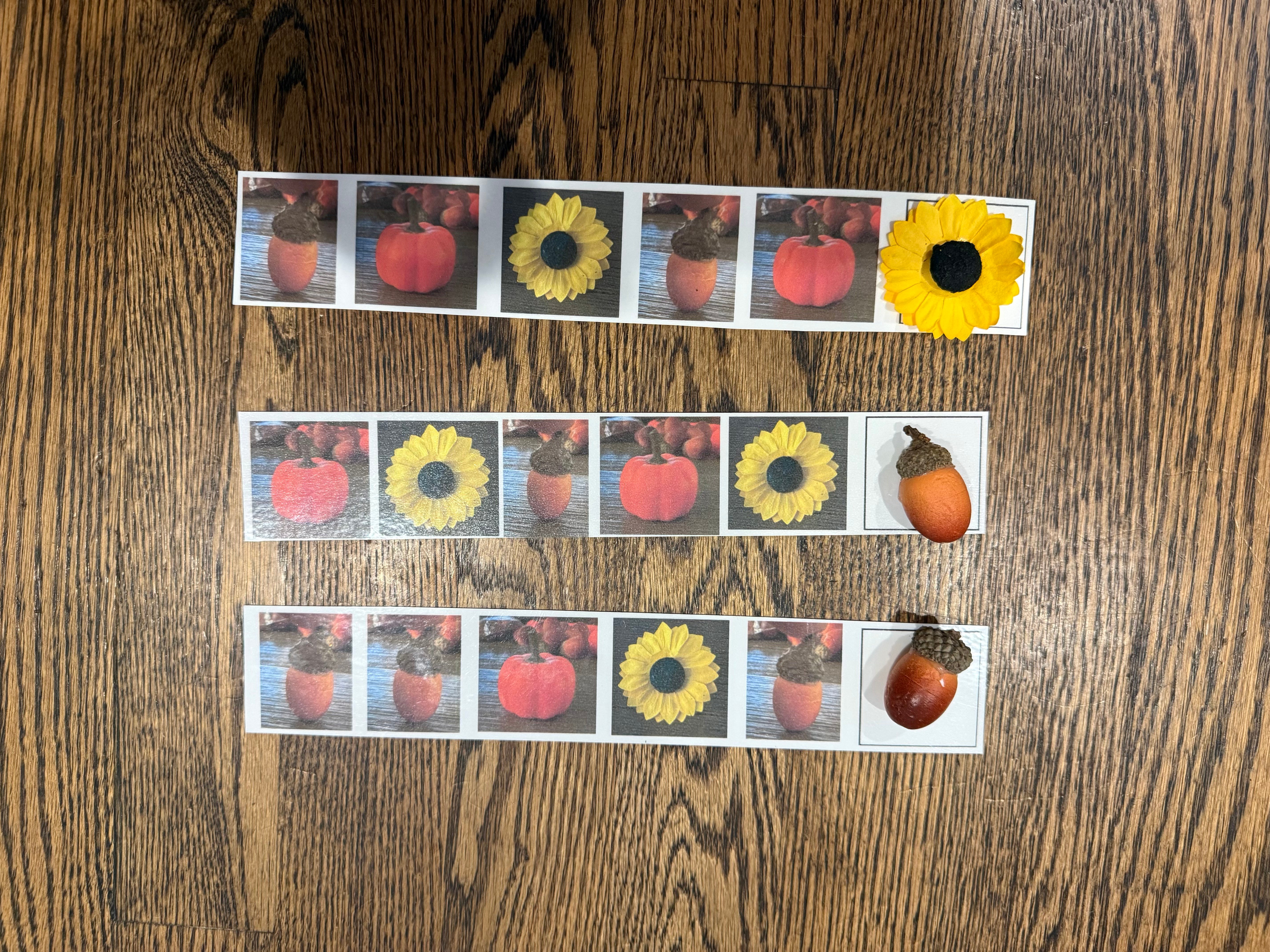
Lay the pattern strips out on the mat. Each strip shows a repeating pattern that ends with a blank space — the child's job is to figure out what comes next and place the correct real object in that space.
Start with simple ABAB patterns (pumpkin, sunflower, pumpkin, sunflower, ?) before moving to ABCABC or AABB patterns.
Once a child can extend the pattern, invite them to cover the strip and recreate the whole pattern from memory using only the real objects. This moves the work from pattern recognition to pattern production.
Why Real Objects Make It Better
The tactile experience of handling real objects — the weight of an acorn, the texture of a dried sunflower — anchors the abstract concept of patterning in something children can actually feel.
It also makes the work look irresistible on the shelf. A printed card next to a pile of real acorns draws children in before they've even thought about math.
Nature objects are free, change with the season, and can be swapped out to keep the same work feeling fresh. Pinecones in October, dried corn in November — the pattern skill stays the same.
Frequently Asked Questions
What if real objects aren't available?
Printed picture cards or small seasonal erasers work just as well. The key is that the "extending" piece is a separate, moveable object — not just pointing at the strip.
How do I know when a child is ready for harder patterns?
When they can extend an ABAB pattern quickly and without hesitation, introduce a third element (ABCABC). When that's solid, try AABB or AABC. Follow the child's lead — frustration means step back, boredom means step up.
Can this activity work for a whole group?
Yes — set up several strips at a table and have children work side by side. Pattern work is naturally self-checking (it either continues correctly or it doesn't), so children can work independently even in a group setting.