How to Introduce Fine Art to Young Children with Montessori Cards
Most adults think of art appreciation as something that requires formal instruction, museum visits, and the ability to sit still and listen to a docent. Young children prove this wrong every time. Given a beautiful reproduction and a few minutes, a three-year-old will tell you more about what they notice in a Van Gogh painting than most adults bother to say.
Why Montessori Art Cards Work
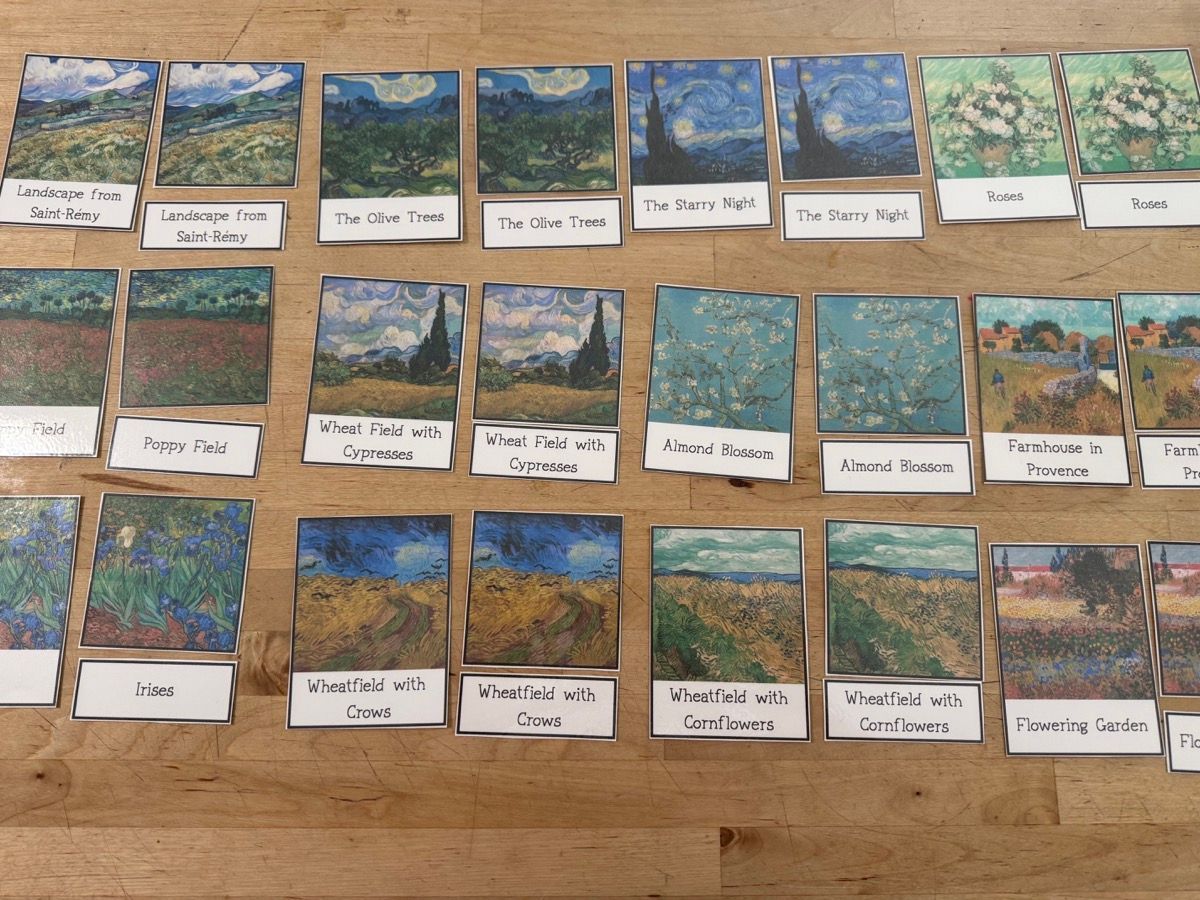
Montessori three-part cards applied to fine art are simple: a full-colour reproduction of a painting on one card, the title on a separate card, and a control card combining both. Children match the title to the painting, learning the names of works through repetition in a context that feels like a game.
The matching work slows children down. To find the card that says "Starry Night," they have to look carefully at each reproduction. That deliberate looking is art appreciation — it just doesn't feel like a lesson.
Why Van Gogh First?
Van Gogh's work is ideal for young children for several reasons. His brushstrokes are bold and visible — children can see the swirling movement in the sky of Starry Night, the thick impasto of the sunflowers. His colour is emotional and immediate. And his subjects (stars, flowers, landscapes) are familiar.
The twelve paintings in our Van Gogh Three Part Cards set span the most recognisable works: Starry Night, Irises, Almond Blossom, Sunflowers, and more. Each work has enough visual distinctiveness that children can identify it reliably after just a few sessions.
How to Present Art Cards
Begin with just three or four paintings. Lay the control cards out on a mat and look at them together, naming each one. "This is Starry Night. What do you notice?" Let the child lead the observation.
Then introduce the matching work: separate picture cards and title cards in two piles, mix them up, and invite the child to match. Control cards go face-down for self-checking.
Over time, extend the work: look up the actual painting in a book or online. Find out when it was made. Ask whether the child has a favourite and why. Art conversation with children is almost always surprising.
Frequently Asked Questions
What age is appropriate for art appreciation cards?
Children as young as 2.5 enjoy looking at and matching art cards, though they won't retain the painting names reliably until around 4. The matching work itself is valuable at any age — the art history knowledge accumulates gradually.
Should I explain the meaning behind paintings?
Follow the child's lead. If they ask questions, answer them simply and honestly. "Van Gogh painted this when he was very sad, and painting helped him feel better" is entirely appropriate for a five-year-old. Lengthy biographical lectures are not necessary or helpful.
Which artists work well after Van Gogh?
Monet (Water Lilies, the garden series) and Klimt (The Kiss, Tree of Life) are popular next steps because of their strong colour and pattern. For a more playful set, Matisse's cut-outs and Kandinsky's abstract work are perennial favourites with young children.